

News
Only a Half Bathroom Downstairs? 5 Practical Ways to Give an Elderly Parent a Safe Ground-Floor Shower

Only a Half Bathroom Downstairs? 5 Practical Ways to Give an Elderly Parent a Safe Ground-Floor Shower
Scenario: a family member uses a walker and cannot stand long enough to manage the stairs to the only full bathroom. Downstairs there is just a half bath, and the family is weighing a half-bath conversion, a portable shower, or something else entirely.
This is one of the most common bathroom problems families face after a parent stops managing stairs well, and the good news is that there are more options than most people realize. Below are the five approaches that actually get used, with honest notes on cost, space, and the traps in each one.
First, be clear about what the shower must do
Before comparing layouts, define the requirement. A senior who uses a walker or wheelchair typically needs:
- A place to sit down while showering, not just a place to stand
- Steady things to hold that are fixed to the wall, not suction cups
- Water they can control while seated
- A step-free path from the bedroom or living area, ideally on the same floor
Every option below should be judged against those four points, not against how it looks.
Option 1: Convert the half bath into a full shower
This is the most common solution and usually the right one if the room has any spare length. The concern you raised, that the toilet area gets cramped, is real, but it can usually be solved with three space-saving tricks:
- A corner shower of 32 by 32 inches (80 x 80 cm) is enough for a seated shower. It does not need to run the length of the room.
- A wall-mounted folding shower seat instead of a fixed bench. It folds flat against the wall when not in use, so the room stays usable as a toilet during the day. This is the single best space-saver for small full baths and is standard equipment in care homes for exactly this reason.
- A sliding or outward-swinging door, never an inward-swinging one. An inward door is useless if someone falls against it.
Watch for two technical points: the drain position (moving it adds cost), and wall blocking behind the shower seat and grab bars so they anchor into structure rather than drywall.
Option 2: A wet-room style conversion of the same half bath
If the room is too tight for even a corner shower enclosure, the wet-room approach removes the enclosure entirely: waterproof the whole floor, slope it to a linear drain, and let the entire room be the shower. Combined with a wall-mounted folding seat and a handheld shower, a 40-square-foot half bath can become a fully usable seated shower.
It costs more than Option 1 because of the waterproofing work, but it is the best answer for very small rooms and for wheelchair users, because there is no threshold and no door at all.
Option 3: Borrow space from a neighboring closet or laundry
If the half bath itself simply cannot fit a shower, look sideways on the floor plan. A hallway linen closet, a laundry room, or a under-stairs storage space that shares a wall with the half bath can often be carved into a compact shower, keeping the toilet where it is. Plumbers call this a “steal-a-closet” conversion, and in older homes it is frequently cheaper than re-plumbing a new location because the supply and drain lines are already in that wall.
Option 4: Make the upstairs shower safe while you plan
Conversions take weeks to schedule and build. Meanwhile the only full shower is up the stairs. Two interim measures keep it usable without a full renovation:
- Fit the existing upstairs shower with a folding wall-mounted seat, grab bars, and a handheld shower. This is a one-day installation, not a renovation.
- Talk to an occupational therapist about stair assessment. A second handrail on the stairs helps more than most people expect; a stair lift is the bigger step.
Option 5: The “portable shower” idea, honestly assessed
Portable camping-style showers and inflatable basins exist, but inside a house they create the exact problems you are trying to avoid: water everywhere, no warm-water supply, no drainage, and a slip hazard that is worse than the original problem. The only version that works indoors reliably is a transfer-friendly setup inside a real enclosure. If a relative suggested a portable shower, redirect that budget toward the folding seat, grab bars, and handheld shower in whichever room you convert. For reference, simple bath stools also exist for parents who can stand briefly but not for a full shower, though a walker user will generally do better with a fixed seat.
What all five options need, regardless of which you pick
Whichever path you take, the safety specification is the same, and it is cheap compared to the construction:
- A seat at 17 to 19 inches (43-48 cm) high, deep enough to sit on comfortably, rated for the user’s weight
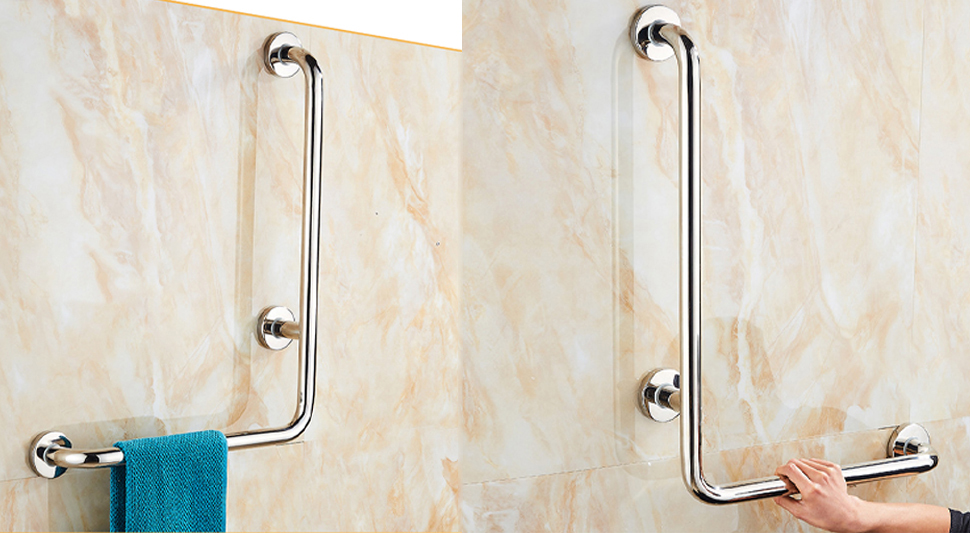
- Grab bars at the entry, beside the seat, and near the water controls, anchored into blocking.ADA guidance puts them at 33-36 inches above the floor. Choose proper bathroom grab bars, never towel bars.
- A handheld showerhead on a slide bar, so the person controls the water while seated
- Non-slip flooring, textured or small-format tile with more grout lines
Quick comparison
| Option | Typical cost (US) | Time | Best when |
|---|---|---|---|
| Half bath + corner shower | $8,000-20,000 | 2-4 weeks | Room has 32 inches of spare width |
| Wet-room conversion | $12,000-25,000 | 3-5 weeks | Room is very small or wheelchair use is likely |
| Closet/laundry conversion | $10,000-22,000 | 3-5 weeks | Half bath cannot fit a shower, shared wall available |
| Upstairs retrofit only | $400-1,500 | 1 day | Interim measure while planning |
Where to start this week
- Measure the half bath: length, width, and the distance from the toilet to the opposite wall.
- Confirm where the drain stack is (a basement or crawlspace makes moving it cheaper).
- Get quotes for Option 1 and Option 3 before committing; the difference is often smaller than expected.
- Order the seat, bars, and handheld shower now, since they are needed in every scenario.
If you are sourcing the seating and bar hardware, a wall mounted folding shower seat from a manufacturer that specializes in this category will outlast hardware-store versions, and models such as the HD-01 folding shower seat are designed specifically for compact bathrooms. For wholesale or project pricing, contact LEMAS here; the factory has supplied care homes and bathroom brands since 1992.